
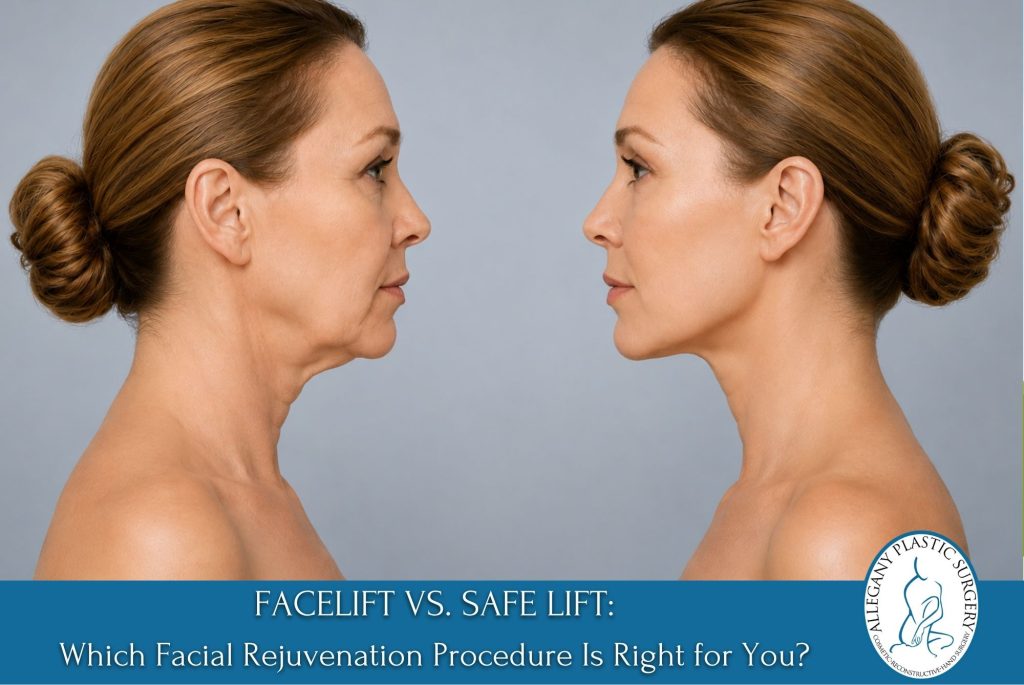
Understanding the Difference Between a Traditional Facelift and a SAFE Lift
When signs of facial aging become more noticeable, many people begin searching for the most effective way to restore a youthful, refreshed appearance. While a traditional facelift has long been considered the gold standard for facial rejuvenation, not every patient requires such an extensive procedure. For individuals with mild to moderate facial sagging, a less invasive option such as the SAFE Lift may provide outstanding results with significantly less downtime.
At Allegany Plastic Surgery, Dr. Robert Carpenter has performed the innovative SAFE Lift (Suture Assisted Facial Elevation) since 2007, helping patients achieve natural-looking facial rejuvenation using minimally invasive techniques under local anesthesia. The procedure was specifically developed for patients who want meaningful improvement without the extended recovery associated with a traditional facelift.
Understanding the differences between these procedures can help you determine which option best fits your goals, anatomy, and lifestyle.
What Is a Traditional Facelift?
A traditional facelift, medically known as a rhytidectomy, is a surgical procedure designed to restore youthful facial contours by repositioning deeper facial tissues, tightening underlying structures, and removing excess skin.
Rather than simply tightening loose skin, modern facelift techniques address the deeper facial anatomy responsible for aging. This comprehensive approach improves:
- Jowls
- Deep nasolabial folds
- Loose skin along the jawline
- Neck laxity
- Sagging cheeks
- Loss of youthful facial definition
A properly performed facelift creates natural-looking rejuvenation rather than an overly tight or stretched appearance. Modern facelift surgery focuses on restoring youthful contours while preserving facial expression.
What Is the SAFE Lift?
The SAFE Lift, which stands for Suture Assisted Facial Elevation, is a minimally invasive facial rejuvenation procedure developed for patients who do not require a full facelift.
Instead of extensive tissue dissection, the SAFE Lift combines:
- Strategic liposuction when appropriate
- Conservative skin removal
- Specialized suspension sutures
- Minimal skin undermining
- Local anesthesia
These suspension sutures gently reposition facial fat pads and neck tissues through small, well-hidden incisions around the ears or hairline. Because the deeper tissues are elevated without extensive surgical dissection, swelling, bruising, and recovery are significantly reduced compared to traditional facelift surgery.
How the SAFE Lift Works
The procedure focuses on lifting facial tissues rather than simply tightening skin.
During surgery, specialized sutures are carefully placed beneath the skin to elevate:
- Midface tissues
- Cheeks
- Jawline
- Neck tissues
- Early jowls
This creates smoother facial contours while maintaining a natural appearance.
Since much less tissue is surgically elevated, patients generally experience:
- Less bruising
- Reduced swelling
- Faster healing
- Minimal discomfort
- Quicker return to normal activities
Many SAFE Lift procedures can be completed in only a few hours under local anesthesia.
Facelift vs. SAFE Lift: Key Differences
Surgical Complexity
A traditional facelift involves more extensive surgical lifting of facial tissues and skin, making it the preferred option for patients with advanced facial aging.
The SAFE Lift is designed for earlier signs of aging and uses minimally invasive suspension techniques rather than comprehensive tissue repositioning.
Anesthesia
Traditional facelifts are commonly performed under general anesthesia or intravenous sedation.
SAFE Lift procedures are typically performed comfortably under local anesthesia, allowing many patients to avoid general anesthesia altogether.
Recovery Time
Recovery after a traditional facelift typically involves more swelling and bruising, with several weeks before patients feel fully comfortable appearing in public.
Patients undergoing a SAFE Lift often return to normal daily activities within several days, with many resuming regular routines in as little as two to three days and overall recovery typically lasting five to seven days.
Best Candidates
Traditional Facelift:
- Moderate to severe skin laxity
- Significant jowls
- Pronounced neck aging
- Deep facial folds
- Advanced facial aging
SAFE Lift:
- Mild to moderate facial sagging
- Early jowl formation
- Good skin quality
- Preserved facial volume
- Busy lifestyle with limited recovery time
Who Is an Ideal Candidate for a SAFE Lift?
Many patients are surprised to learn they do not yet require a traditional facelift.
The best candidates typically have:
- Mild facial sagging
- Early jowls
- Good skin elasticity
- Smooth skin texture
- Minimal facial volume loss
- Desire for subtle, natural improvement
- Limited downtime available
Patients often choose the SAFE Lift because it provides meaningful rejuvenation without the commitment of larger surgery.
When Is a Traditional Facelift the Better Choice?
While the SAFE Lift offers remarkable benefits, it cannot replace a comprehensive facelift for everyone.
Patients with:
- Significant loose skin
- Advanced jowling
- Extensive neck laxity
- Deep facial folds
- Significant facial volume loss
often achieve more complete and longer-lasting correction with a traditional facelift.
A consultation allows Dr. Carpenter to evaluate your facial anatomy and recommend the procedure that will provide the most natural outcome.
Can Either Procedure Be Combined with Other Treatments?
Yes.
Facial rejuvenation often produces the best results when procedures are customized to each patient’s anatomy.
Depending on your needs, either procedure may be combined with:
- Brow lift
- Eyelid surgery (blepharoplasty)
- Facial fat grafting
- Dermal fillers
- Laser skin resurfacing
- Medical-grade skincare
- Injectable wrinkle relaxers
These complementary treatments address multiple aspects of facial aging simultaneously for balanced, harmonious results.
Recovery Expectations
SAFE Lift Recovery
Most patients experience:
- Mild swelling
- Mild bruising
- Temporary tenderness
- Head elevation during the first few days
- Rapid improvement throughout the first week
Many patients comfortably return to work and normal activities within several days.
Traditional Facelift Recovery
Recovery generally includes:
- More noticeable swelling
- Bruising
- Activity restrictions
- Longer healing timeline
- Gradual improvement over several weeks
Although recovery takes longer, patients with more advanced aging often find the dramatic improvement well worth the investment.
Will My Results Look Natural?
One of the biggest concerns patients have is looking “overdone.”
Modern facial rejuvenation techniques prioritize restoring youthful facial structure rather than creating excessive skin tension.
Both procedures are designed to:
- Preserve facial expression
- Maintain natural movement
- Avoid an overly tight appearance
- Enhance facial harmony
- Refresh rather than dramatically alter your appearance
Choosing the appropriate procedure based on your anatomy is one of the most important factors in achieving natural-looking results.
Why Experience Matters
Facial anatomy is incredibly complex, and every patient ages differently.
Successful facial rejuvenation requires:
- Comprehensive facial analysis
- Individualized treatment planning
- Advanced surgical techniques
- Artistic judgment
- Attention to facial balance
At Allegany Plastic Surgery, Dr. Robert Carpenter tailors every facial rejuvenation procedure to the patient’s unique anatomy, goals, and degree of aging to achieve beautiful, balanced results.
Frequently Asked Questions
Is the SAFE Lift permanent?
The procedure provides long-lasting rejuvenation, but it does not stop the natural aging process. Maintaining healthy skin and protecting it from sun damage can help prolong your results.
Does the SAFE Lift leave visible scars?
Incisions are placed around the ears and within the hairline where they are carefully concealed.
Is a SAFE Lift painful?
Most patients experience only mild discomfort that is easily managed with prescribed medications and routine postoperative care.
How long does a SAFE Lift take?
The procedure is often completed within a few hours under local anesthesia.
Can I avoid general anesthesia?
Yes. One of the advantages of the SAFE Lift is that it is commonly performed using local anesthesia.
How long is recovery after a SAFE Lift?
Most patients return to many normal activities within two to three days, with recovery generally lasting five to seven days.
How long does facelift recovery take?
Recovery varies, but traditional facelift surgery typically requires more downtime due to increased swelling and bruising compared to a SAFE Lift.
Which procedure lasts longer?
A traditional facelift often produces longer-lasting correction because it addresses more advanced facial aging. However, both procedures provide durable improvements when appropriately selected.
Am I too young for a facelift?
Not necessarily. The decision is based on facial anatomy rather than age alone. Some younger patients benefit from a SAFE Lift, while others with more advanced aging may benefit from a traditional facelift.
How do I know which procedure is right for me?
A personalized consultation with Dr. Carpenter is the best way to determine whether your anatomy and goals are better suited for a SAFE Lift or a traditional facelift.
Schedule Your Facial Rejuvenation Consultation
If you’re considering facial rejuvenation but aren’t sure whether a traditional facelift or the minimally invasive SAFE Lift is right for you, the experienced team at Allegany Plastic Surgery can help you make an informed decision. During your consultation, Dr. Robert Carpenter will evaluate your facial anatomy, discuss your cosmetic goals, and recommend the procedure that offers the safest, most natural-looking results.
Contact Allegany Plastic Surgery
Allegany Plastic Surgery
911 Seton Dr
Cumberland, MD 21502
Phone: (301) 724-5885
Website: https://alleganyplasticsurgery.com
Request an Appointment: https://alleganyplasticsurgery.com/appointments/